Getting around
Can You Pay for Amsterdam Transport With a Card?
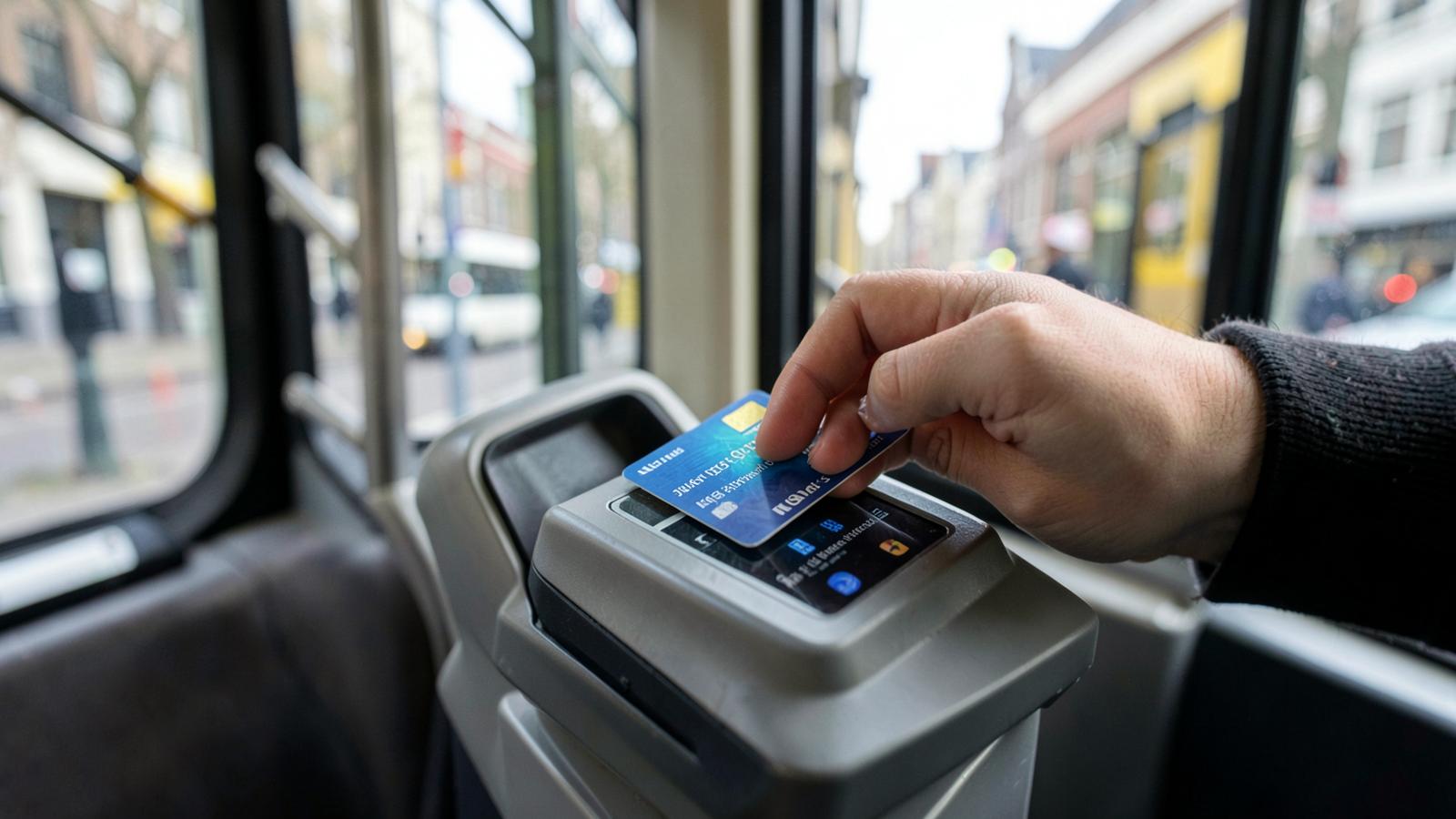
Yes, in short: Amsterdam's entire public transport network runs on contactless payment, and for most visitors there is no ticket to buy at all. The details around tapping in, tapping out and what happens when it goes wrong are worth knowing before your first ride, though.
The system is called OVpay, and it now covers GVB trams, buses, metro and ferries as well as NS trains across the Netherlands. It works alongside the older OV-chipkaart, but for a visitor with a contactless bank card or a phone set up for mobile payments, there is genuinely nothing else to arrange.
How OVpay works
You tap your contactless bank card, credit card, phone or smartwatch on a yellow-and-grey reader at the start of your journey, then tap again at the end. On the metro, this happens at the gates; on trams and buses, at readers near the doors; on NS trains, at readers on the platform before boarding and after leaving.
- Tap in before you board a tram or bus, or before passing through metro gates.
- Tap out again when you leave, using the same card, phone or watch you tapped in with.
- Fares are calculated by the distance actually travelled between the two taps, not a flat fare.
- You do not need to pre-register a card; it works the first time you tap, and the fare shows up on your normal bank statement.
Distance-based fares
Because fares depend on distance, a short hop of a few stops costs noticeably less than crossing the whole city. This differs from cities with a flat fare per ride, so do not assume every journey costs the same. GVB and NS also charge separately from each other, so a trip combining a train and a tram will show as two distinct charges.
Which cards work
Most major contactless debit and credit cards work, including Visa, Mastercard and Maestro, along with mobile wallets such as Apple Pay and Google Pay, and contactless-enabled smartwatches. The card needs the contactless symbol (the curved lines) to be usable this way.
- Standard contactless debit or credit cards: work directly, no setup needed.
- Mobile phone wallets: work the same way, tap the phone rather than a physical card.
- Prepaid or virtual cards: usually work if they support contactless payment, though some prepaid cards have restrictions worth checking with your provider before you travel.
- Cards without contactless enabled: will not work; you would need a physical OV-chipkaart or a paper ticket instead.
Foreign cards and fees
Foreign-issued cards work in the same way as Dutch ones, since OVpay simply processes a standard contactless payment. Your own bank may apply a foreign transaction fee or currency conversion charge, which is worth checking before you travel, since it depends on your card provider rather than on OVpay or GVB.
Group travel
Each traveller needs their own contactless card or device; you cannot tap one card for multiple people entering together, since the system tracks each card's individual tap-in and tap-out. Families or groups should make sure every member, including older children, has their own card or phone ready before boarding, particularly at metro gates where only one person can pass per tap.
Trains vs GVB: what differs
On NS trains, tapping in and out happens at fixed poles on the platform, not on board, so you must tap before boarding and again after leaving the platform at your destination, even if you are just transferring. On GVB trams and buses, the readers are on board near the doors, and on the metro they sit at the gated entrances and exits, similar to the London Underground.
| Mode | Tap-in location | Tap-out location |
|---|---|---|
| Tram | Reader near the door you board through | Reader near the door you exit through |
| Bus | Reader near the entrance | Reader near the exit |
| Metro | Gate at station entrance | Gate at station exit |
| NS train | Pole on the departure platform | Pole on the arrival platform |
| Ferry (IJ crossings) | Free, no tap needed | Free, no tap needed |
What happens if you forget to tap out
If you forget to tap out, the system cannot calculate the actual distance you travelled, so it charges a maximum fallback fare for that journey instead of the real one. This is usually noticeably more expensive than a normal fare, so it is worth building tapping out into habit, especially when you are distracted by luggage or getting off in a rush.
Refunds and disputes
OVpay provides an online portal where you can review your journey history and raise a dispute for an incorrect charge, such as a double tap-in or a fare that looks wrong. Keep an eye on your bank statement or the OVpay app in the days after travelling, since fares are not always shown instantly.
Inspections and fines
Both GVB and NS carry out ticket inspections, on trams and buses as well as on trains, checking that passengers have a valid tap-in. Travelling without one, or having tapped in but not out from a previous journey, can result in an on-the-spot fine well above the cost of the fare itself. Inspectors can be in plain clothes as well as uniform, so treat tapping in as non-negotiable rather than optional.
Final tips
For nearly everyone visiting Amsterdam, a contactless card or phone is all you need; there is no ticket machine to find and no card to buy in advance. If you expect to take a lot of rides in a single day, it is still worth weighing that against a day pass, covered in our comparison of Amsterdam travel cards, and for the wider network layout see our public transport guide.
Frequently asked questions
- Do I need to buy an OV-chipkaart to use Amsterdam transport?
- No. Most visitors can use OVpay with their own contactless bank card or phone instead, with no separate card to buy or top up.
- Will my foreign card work with OVpay?
- Yes, as long as it supports contactless payment. Your bank may apply its own foreign transaction fee, which is worth checking beforehand.
- What happens if I tap in but forget to tap out?
- You will be charged a maximum fallback fare for that journey, since the system cannot calculate the actual distance travelled. You may be able to dispute it via the OVpay website.
- Can one person tap in for a whole group?
- No, each traveller needs to tap in and out individually with their own card, phone or watch.
- Do GVB and NS charge the same way with OVpay?
- They use the same contactless system but bill separately, so a trip combining a train and a tram or metro will appear as two separate charges.
- Are Amsterdam's ferries also paid through OVpay?
- No, the GVB ferries across the IJ are free for pedestrians and cyclists, with no tap-in required.
Sources
Keep reading
Guides that pair well with this one.
Getting around
Amsterdam Travel Cards: Which One Is Best?
GVB passes, the Amsterdam Travel Ticket, City Card and OVpay compared honestly, with a break-even table for who each option actually suits.
10 min read
Getting around
Amsterdam Public Transport: The Complete Guide to Trams, Metro, Buses and Ferries
How to use GVB trams, metro, buses and ferries in Amsterdam, from OVpay tap-in to day passes and night buses.
12 min read

Getting around
How to Use the Amsterdam Metro
Lines 50 to 54, the Noord/Zuidlijn, interchanges, gates, hours and accessibility on Amsterdam's metro, plus when it beats the tram.
9 min read

Getting around
The Amsterdam Tram Guide: Key Lines, Fares and Etiquette
How Amsterdam's trams work, the most useful lines for visitors, boarding rules, fares and unwritten etiquette to know before you ride.
9 min read
Opening hours and prices change. Always check official websites before you travel. Read our disclaimer.